Stove and cooktop repair in King City
Gas, electric and induction fail in different ways, so here are the four we see most across all three. Under each are the causes our techs usually find once the cooktop comes apart.
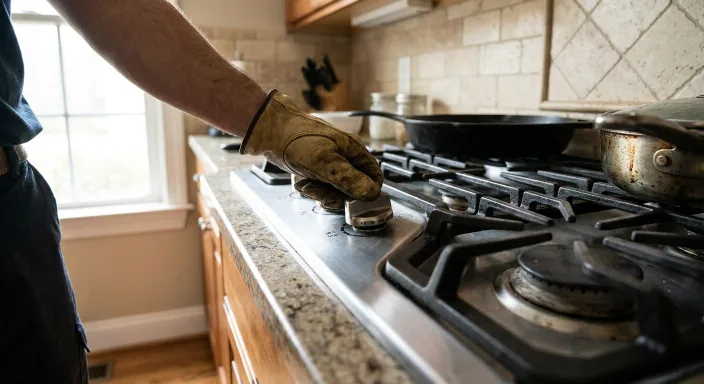
A burner that clicks and clicks without catching, or lights on one side of the ring only, is the call we get most on gas ranges.
-
Blocked burner ports
Boil-overs leave sugar and grease in the small slots around the burner cap. Gas can't get out evenly, so you get a lazy flame or none at all.
-
Worn spark igniter
If the clicking sounds weak or has stopped altogether, the electrode or its wiring has usually failed. One faulty igniter can make every burner click at once.
-
Spark module or switch
When all four burners click nonstop even with the knobs off, the module or a switch that thinks it's on is normally behind it.
Check this first: Take the burner cap off and check it's seated flat and dry. A cap sitting crooked after cleaning stops a burner lighting more often than you'd think.
One dead element, or a burner stuck on full heat with no control in between, points to the element itself or the switch behind the knob.
-
Burnt-out coil or radiant element
Elements fail with age. On a coil range you'll sometimes see a blister or a break, but plenty die with no visible damage at all.
-
Failed infinite switch
This is the switch behind the knob that cycles power on and off to set the heat. When it sticks, the element either stays cold or runs flat out.
-
Loose element receptacle
On coil ranges, the block the element plugs into can burn and lose contact. We replace the receptacle along with the element.
Check this first: Swap a working coil element into the dead position. If it heats, the element was the problem. If it doesn't, the trouble is in the switch or wiring.
Induction tops are quick and efficient, and they also fail in ways that gas and electric never do.
-
Cookware that isn't magnetic
Induction only works with magnetic pans. If a fridge magnet won't stick to the base, the cooktop can't heat it. Copper and most aluminum won't work.
-
Cooling fan or overheating
The electronics underneath need airflow. When the fan clogs or fails, the top shuts down partway through cooking and shows an error.
-
Failed coil or control board
A single zone that's dead while the rest work usually means that zone's coil or its board section has gone.
Check this first: Try a different pan first, and make sure it covers most of the ring. A small pot on a large zone sometimes won't register at all.
A range pulls a lot of power. Anything electrical that looks or smells wrong is worth stopping for rather than working around.
-
Damaged element or wiring
A cracked element can arc against the pan or the drip bowl. Stop using that burner and switch the range off at the breaker until it's looked at.
-
Burnt terminal block
The block where the range cord connects at the back can overheat and char. It's a common cause of a dead oven with working burners, or the reverse.
-
Cracked glass cooktop
A crack in a ceramic top lets spills reach the wiring underneath. It's a safety issue, not a cosmetic one, so the top shouldn't be used.
Check this first: If the breaker trips every time you switch a burner on, leave it off and call. Repeatedly resetting a breaker hides a fault that needs finding.